24 October 2026 · 10 min read
Michelin Keys and Hotel Design: What Inspectors Notice Before Anyone Speaks
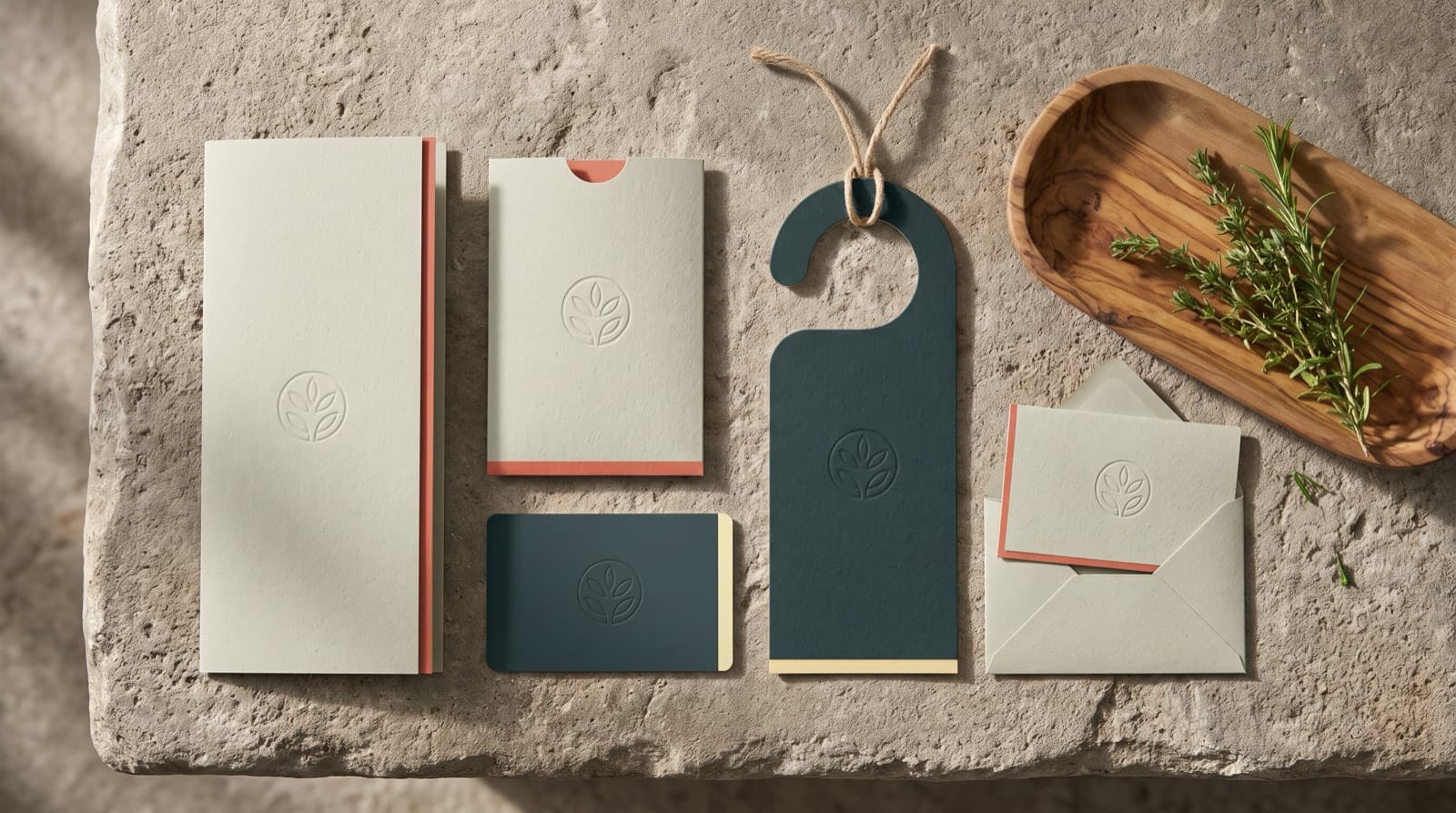
A Michelin inspector doesn't arrive with a clipboard. They book online like anyone else, pay for the room, collect a key card at reception and find their own way to the lift. Nobody on your team knows who they are, so nobody gets the chance to make a special effort.
Which means the first things to speak for your hotel aren't your staff. They're your website, your key card, your signage and your breakfast menu.
The short version: Michelin judges hotels on five criteria. Two of them — personality and a sense of place — are expressed constantly through the small designed objects a guest handles, and a third, consistency, is something guests feel the moment those objects stop matching. Design won't win a Key on its own. But it decides whether everything else you do reads as one hotel or as ten.
Key takeaways
- Keys can't be applied for or bought. Inspectors choose from the 9,000+ hotels already in the MICHELIN Guide, stay anonymously and pay their own way.
- The bar is high. The 2026 selection has 2,832 Key hotels worldwide. Only 155 hold Three Keys.
- Design shows up in more than one criterion. Architecture and interiors are judged directly, but personality and sense of place are largely communicated through design too.
- Inspectors experience your hotel as a sequence of small moments. Booking page, key card, signage, menu, door hanger. Each one either confirms the story or breaks it.
- Sense of place is not decoration. Local motifs pasted onto generic materials read as a souvenir shop, not a hotel rooted in where it is.
- You can test this yourself tomorrow. Walk through your own hotel as a stranger and put every printed and digital touchpoint on one table.
What a Michelin Key actually is
Michelin has awarded restaurant stars since the 1920s. In 2024 it introduced the Key, its equivalent for hotels, and in October 2025 it published the first global selection.
The second, announced on 18 September 2026, covers 2,832 hotels:
| Distinction | Michelin's definition | Hotels in 2026 |
|---|---|---|
| One Key | "A very special stay" | 2,020 |
| Two Keys | "An exceptional stay" | 657 |
| Three Keys | "An extraordinary stay" | 155 |
Two things make the Key different from most hotel awards. First, there is no application, no entry fee and no sponsorship tier. Keys are chosen from hotels already in the MICHELIN Guide's selection, which itself numbers more than 9,000 properties. Second, inspectors are anonymous. They stay as ordinary paying guests, and Michelin covers the bill.
So there is no version of this where you prepare for the inspection. The inspection is simply a normal stay — which is the point.
The five criteria inspectors judge
Michelin applies the same five criteria to every hotel in its selection. In its own words:
- The hotel is an open door to the destination — a place in harmony with its surroundings, reflecting local identity.
- Excellence in interior design and architecture.
- Quality and consistency in service, comfort and maintenance.
- Consistency between the level of experience and the price paid.
- Individuality, reflecting personality and authenticity.
Read them as a designer and they divide quite cleanly. Architecture and interiors belong to architects and interior designers. Service, comfort and maintenance belong to the operation and the team. Value is a commercial decision.
But the first and the last — sense of place and individuality — are carried to a surprising degree by brand and graphic design. And while the consistency in criterion three refers to service, guests experience consistency visually as well. A hotel whose welcome letter, menus and signage look like they were made for three different properties doesn't feel consistent, however good the service is.
That's the territory this article covers: not the building, but everything a guest holds, reads and scrolls through between booking and checkout.
An inspector's stay is made of small moments
Nobody experiences a hotel as a brand. They experience it as a sequence of screens and objects, usually in roughly this order.
The website they book on
This is the first impression, and for an anonymous inspector it's also the first piece of evidence. Does the site feel like this hotel, or like a booking template with your photos dropped in? Does the photography show the place — the street, the light, the view, the materials — or only rooms that could be anywhere? A generic website promises a generic stay before anyone has arrived.
The key card in their hand
Small, cheap to get right and almost always overlooked. Most hotels use whatever the lock supplier provides, or a logo dropped onto a stock colour. Yet it's the one branded object every guest touches, repeatedly, for the length of their stay. A key card that carries the hotel's character — its material, its colour, a detail drawn from the building — tells a guest that someone cared down to the smallest thing.
The signage to the lift
Wayfinding is where personality usually goes to die. The lobby gets designed; the corridors get off-the-shelf plaques in whatever typeface the sign maker had. Inspectors walk those corridors too. Signage that uses the same typography, materials and tone as the rest of the brand keeps the story going in the parts of the building nobody photographs.
The breakfast menu
Menus are read slowly and closely, which makes them unforgiving. Mismatched type, an old version of the logo, a translation that reads like a machine wrote it, a laminated sheet in a hotel that otherwise feels considered — all of it shows here. The menu is also one of the most honest places to express a sense of place: local producers, regional names for dishes, a short line about where something comes from.
The Do Not Disturb sign
It hangs on the door for hours, seen by everyone who walks the corridor, and it's usually designed last, if at all. But it's also one of the few places the hotel's voice speaks directly. The tone of a two-word message says a surprising amount about the personality of a place.
And everything around them
The pre-arrival email. The welcome card. The room directory, printed or on a tablet. The minibar list, the spa leaflet, the invoice at checkout. None of these will win a hotel an award on its own. Together, they're the difference between a stay that feels authored and one that feels assembled.
Sense of place, without the souvenir shop
"An open door to the destination" is the criterion most easily misread. The tempting interpretation is decorative: a local pattern on the cushions, a landmark on the letterhead, a regional motif worked into the logo.
That isn't sense of place. That's a theme.
Real sense of place comes from things that are specific and true: the building's own history, the materials of the region, the colours of the landscape, the local typographic tradition, the producers and makers nearby. It's quieter than a motif and far harder to fake, which is exactly why it gets noticed. A beautiful location isn't the same thing either — plenty of hotels with remarkable views could otherwise be anywhere.
The same trap catches hotels marketing to international guests, where cliché reads as disrespect, and it's much of what separates genuinely great boutique hotel branding from merely pretty branding.
Personality is a point of view
Michelin describes a One Key hotel as "a true gem with personality". In a brand, personality isn't a mood board or a colour palette. It's a set of decisions held consistently: what the hotel would say and what it never would, what it chooses to show and what it leaves out.
Hotels without a clear point of view tend to look like their competitive set, because every choice quietly defaults to what everyone else is doing. The result is pleasant and forgettable. Defining that point of view before any design work begins is the core of a hotel brand identity.
Consistency: one hotel, not ten
If each touchpoint looks like it came from a different hotel, the story breaks. This happens to good hotels all the time, and rarely because of a bad designer. It happens because the website was built by one agency, the menus by the F&B team, the signage by the fit-out contractor and the spa leaflet by the spa operator — each working from a logo file and nothing else.
The fix isn't more design. It's a shared reference: a brand book that tells everyone who touches the brand what's fixed, what's flexible and how the hotel sounds. It turns consistency from something that depends on one careful person into something the whole operation can maintain.
Walk through your hotel as a stranger
You don't need an inspector to see what an inspector sees. Try this:
- Book a room on your own website from a phone, as a first-time guest would. Note the moment it stops feeling like your hotel.
- Collect every printed piece a guest can touch — key card, welcome letter, menus, room directory, door hangers, spa and minibar lists — and lay them out on one table.
- Cover the logo on each one. Would a stranger still know they all came from the same hotel?
- Walk the back corridors and lift lobbies. Is the signage part of the brand, or part of the building services?
- Ask what each piece says about where you are. If it could belong to a hotel in any other city, it isn't contributing to a sense of place.
If that turns up more than a few mismatches, a structured hotel brand audit will tell you whether you're looking at a consistency problem or something deeper.
What design can't do
It's worth being honest about the limits. Design won't earn a hotel a Key on its own. No key card makes up for slow service, and no menu rescues a tired room. Michelin weighs architecture, service, comfort and value alongside everything above, and a hotel has to deliver on all of them.
What design does is hold the experience together. It's the thread that runs from the booking page to the checkout invoice, and it decides whether an inspector — or any guest — leaves with a clear memory of one specific place, or a vague impression of a nice hotel somewhere.
Frequently asked questions
Can a hotel apply for a Michelin Key? No. There is no application process and no fee. Keys are awarded by Michelin's anonymous inspectors to hotels already in the MICHELIN Guide selection.
How many hotels have a Michelin Key? The 2026 selection, announced in September 2026, includes 2,832 hotels worldwide: 2,020 with One Key, 657 with Two Keys and 155 with Three Keys.
What do Michelin inspectors look for in a hotel? Five criteria: the hotel as an open door to its destination; excellence in architecture and interior design; quality and consistency of service, comfort and maintenance; value relative to price; and individuality reflecting personality and authenticity.
Is a Michelin Key the same as a Michelin star? No. Stars go to restaurants and Keys go to hotels, and Michelin decides them independently. A hotel can hold Keys while its restaurant holds no star, and the other way round.
Can a small or independent hotel earn a Michelin Key? Yes. Size and grandeur aren't criteria in themselves — Michelin's own description of a One Key hotel is "a true gem with personality". Independent and boutique hotels often have a natural advantage on character and sense of place, provided the experience is delivered consistently.
Does branding affect a Michelin Key? Not directly — there's no criterion called branding. But personality, sense of place and consistency are all communicated partly through design, from the website to the in-room materials, so a coherent brand helps the qualities inspectors look for come through clearly.
A hotel's story is told across dozens of small things — booking pages, key cards, menus, signage — and I design across all of them, in English, Turkish, Russian and Ukrainian.
If you'd like a fresh pair of eyes on whether your hotel tells one story from booking to checkout, get in touch.
Looking for a designer for your hospitality brand?
Elina Imre is a senior graphic designer specialising in brand identity for hotels and resorts, available for part-time and freelance projects.
Get in touch