1 July 2026 · 8 min read
Hotel Social Media Content: What to Post and When
Design gives your hotel social media a visual system. Content is what fills it — day after day, week after week. And for most hotel teams, that is where the real struggle lives: not knowing what to post, running out of ideas, or falling back on the same few types of content until the feed goes quiet.
This is a practical guide to hotel social media content: what performs, how to plan ahead, and how to make content creation manageable for a team that already has a full-time job running a property.
The short version: great hotel social media content is not about posting more. It is about posting the right things, consistently, in a way that feels effortless to guests and gives them a reason to stop scrolling.
What to post on hotel social media: proven content types
The hotels with the best-performing feeds are not doing anything exotic. They are rotating through a short list of content types that reliably work for hospitality:
1. Property moments The rooms, corridors, terraces, pool, lobby — but captured with intent. Not a phone snap of an empty bed. A morning light detail. An architectural frame from an angle guests never see. A beautifully set table at dusk. The goal is to make a follower feel the atmosphere before they book.
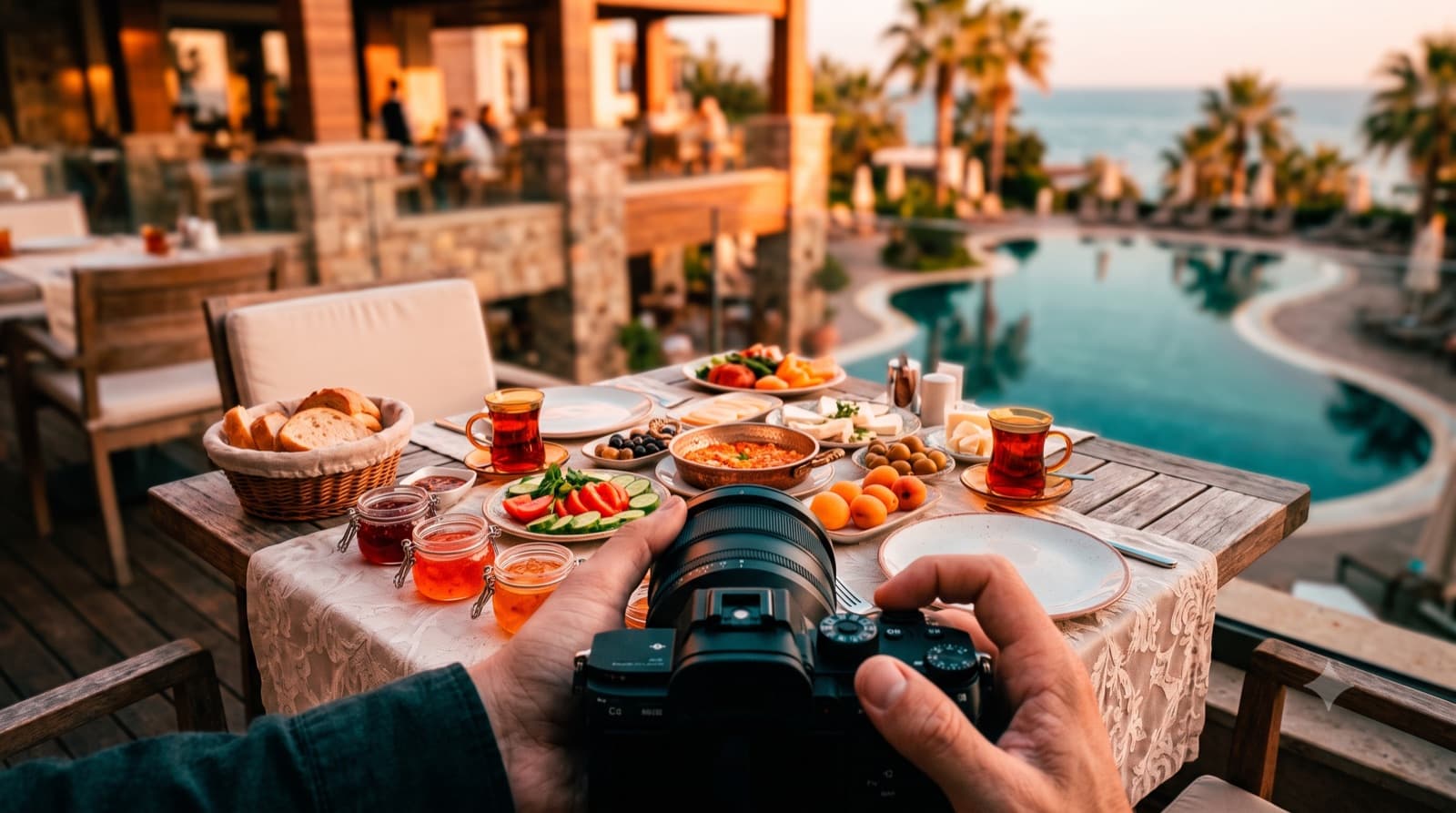
2. Food and drink If your property has a restaurant, bar, or breakfast service, this is some of your highest-performing content. A perfectly made espresso, a seasonal dish plated well, a cocktail caught in golden hour — hospitality audiences respond to these immediately.
3. The local area Your guests are not just booking a bed; they are booking access to your location. A nearby beach, a local market, a hidden view — content that sells the destination sells the stay. This is also the category that gets shared most, because it is useful, not just pretty.
4. Behind the scenes The chef prepping, the team at morning setup, a florist arranging the lobby — this content builds trust and warmth. It shows that real people who care about the place are looking after it.
5. Guest moments With permission, reposting a beautifully shot guest photo or story adds social proof and shows real people enjoying the property. The bar should be high — only reshare what actually represents the brand well.
6. Offers and packages — sparingly Promotions work on social, but only if they are in the minority. A feed that is mostly offers trains followers to wait for discounts rather than book at full rate. Aim for no more than one in five posts being explicitly promotional.
How to build a hotel social media content calendar
An unplanned feed goes quiet the moment the team gets busy. A simple content calendar changes that.
Block in the anchors first. Known dates — seasonal events, local festivals, public holidays, key travel booking windows — go in first. Content around these creates urgency and relevance.
Assign content pillars to days. For example: Mondays = property detail, Wednesdays = food or drink, Fridays = destination or local content. This gives whoever is creating content a clear brief without having to reinvent the wheel each week.
Batch-create where you can. A 90-minute property walkthrough with a phone — or better, a regular session with a photographer — produces enough images for two to three weeks of posts. Most hotels under-invest in asset creation and then over-struggle with what to post.
Leave room for spontaneous content. A stunning sunset, an unexpected event, a lovely guest moment — these perform well precisely because they are genuine. A good calendar has structure but not so much structure that it blocks the real thing.
Caption writing for hospitality brands
A great image paired with a weak caption loses half its impact. A few principles that work consistently for hotel social media:
- Lead with the feeling, not the fact. "Wake up to this." beats "Our rooms have garden views." every time.
- Keep it short on Instagram, longer on Facebook. Instagram audiences skim; Facebook audiences read. Write accordingly.
- Use a clear call-to-action. "Link in bio to book" or "DM us for availability" removes the guesswork for someone who is actually ready to enquire.
- Match the caption tone to the brand voice. A luxury property sounds unhurried and considered. A lively boutique property sounds warm and personal. Your brand guidelines should define this tone, and every caption should stay inside it.
- Avoid generic hospitality clichés. "The perfect getaway awaits" tells a follower nothing they haven't read fifty times today. Specific and honest always outperforms vague and glossy.
How often should hotels post on social media?
The honest answer: consistently at a level you can actually sustain, rather than intensively at a level you will drop in a month.
For most hotel teams working without a dedicated social media manager, three to five posts per week on Instagram is a realistic and effective target. That is enough to stay present in the algorithm without burning out the team or depleting the image bank.
Stories can absorb more spontaneous daily content without affecting the main grid. Reels — short video content — tend to reach new audiences far better than static posts, so one or two per month is worth prioritising even if video is not a natural format yet.
Quality over frequency is always the right call. A feed with a strong visual design system means even a moderate posting cadence looks polished and intentional.
Simple ideas for in-house content creation
Not every hotel has a budget for professional shoots every month. These approaches produce strong content without professional equipment:
- A designated "content hour" per week — someone walks the property, captures details, grabs a few video clips. Not a photoshoot; just intentional observation.
- Golden hour routines — the hour after sunrise and before sunset produces naturally beautiful light and requires almost no editing. Build it into the team schedule.
- Staff knowledge content — a short video of your chef explaining the dish of the day or a bartender describing a signature drink is genuinely interesting and costs nothing but a minute of filming.
- Seasonal resets — each time the property changes for a season, a holiday, or an event, that is a ready-made content opportunity. Document the setup; it often looks as good as the finished result.
If budget allows, one professional shoot per quarter — capturing a season's worth of hero images — is far more efficient than ad hoc photography every week.
Turning social media content into bookings
Content builds an audience. Converting that audience into guests requires a few deliberate choices:
- The link in bio should always point somewhere useful — a booking page, a seasonal offer, or a specific landing page. Not just the homepage.
- Stories with a "Book Now" or "DM us" sticker make it frictionless for a warm follower to enquire immediately.
- Consistent saves and follows are the signal — someone who saves five of your posts is mentally planning a stay. This is exactly the audience retargeted ads reach effectively.
- A well-designed feed builds trust — which is what converts an admirer into a booker. This is why the visual design of your social content and the quality of that content are not separate things.
Key takeaways
- Rotate through proven content types: property moments, food and drink, local area, behind the scenes, guest content, and occasional offers (not the majority).
- A simple content calendar with pillar days and batched asset creation makes consistency manageable — no calendar = the feed goes quiet when the team gets busy.
- Captions should lead with feeling, match the brand voice, and end with a clear call-to-action.
- Three to five posts per week is a sustainable and effective cadence for most hotel teams.
- Turning content into bookings requires a clear link-in-bio path, Stories CTAs, and a feed that builds enough trust to convert admiration into enquiry.
Frequently asked questions
What type of content works best for hotel Instagram? Property atmosphere shots, food and drink, and local destination content consistently perform best. Behind-the-scenes content builds warmth and trust. Offers should be a minority of the content, or they train followers to wait for discounts.
How many times a week should a hotel post on Instagram? Three to five times per week is a realistic and effective target for most hotel teams. Consistency matters more than volume — a steady cadence at quality will outperform intense bursts followed by silence.
Do hotels need a professional photographer for social media? Not every week — but a quarterly professional shoot for hero images makes a significant difference. Day-to-day content can come from intentional in-house capture (golden-hour routines, a weekly content hour) when there is a clear visual direction to work from.
How do I turn hotel social media followers into bookings? A useful link-in-bio that goes to a booking or enquiry page, Stories with booking CTAs, and a feed that is visually strong enough to build genuine trust. Followers who save your posts are often close to booking — that is the audience retargeted ads convert most efficiently.
Elina Imre is a senior graphic designer specialising in brand identity and social media design for the travel and hospitality industry, working across Europe and beyond.
Looking for a designer for your hospitality brand?
Elina Imre is a senior graphic designer specialising in brand identity for hotels and resorts, available for part-time and freelance projects.
Get in touch